

Skin Tag (Acrochordon) Treatment | IC Clinic Shinjuku
“I want to remove my skin tags, but what options are available?”
“What does skin tag surgery involve? Will it be painful?”
“I have a growth that looks like a skin tag, but I’m not sure if that’s really what it is.”
Are you concerned about a growth that may be a skin tag?
Skin tags are benign skin growths. However, if left untreated, they may multiply or grow larger, so it is worth considering a consultation at a clinic.
On this page, we explain the following topics about skin tags.
- Causes of skin tags
- How to distinguish them from other conditions
- Symptoms
- Treatment options
We hope this information helps you address your skin tag concerns.
What Are Skin Tags? Growths That Commonly Appear on the Neck and Underarms

Skin tags are benign growths that commonly develop on the neck, underarms, and similar areas [1,2,18].
Medically, they are known as “acrochordon” or “skin tag,” and are an extremely common benign skin condition seen in adults from middle age onward [2,10].
The growths are typically 1–3 mm in size and appear raised above the skin surface. When they first appear, they are small, but they gradually enlarge over time and may develop a pedunculated (hanging) shape.
The growths also tend to become more noticeable over time, as their number tends to increase with age.
Skin tags most often begin to appear from around age 30 onward and are more common in women and individuals with obesity [2,19].
Epidemiological studies report that approximately 46% of adults aged 50 and over are affected, with women developing the condition at approximately 1.5 times the rate of men [2,19].
In particular, individuals with a body mass index (BMI) of 25 or higher have been found to have approximately 2–3 times the risk of developing skin tags [11,20].
Causes of Skin Tags
The following four factors are considered to play a role, though no single definitive cause has been identified [1,2].
Recent research has revealed that skin tags are not simply a result of aging, but are strongly associated with metabolic abnormalities such as insulin resistance and diabetes [3,5,8,9].
Patients with diabetes have been reported to develop skin tags at approximately 3–4 times the rate of healthy individuals [8,20].
- UV exposure
- Skin aging
- Friction
- Obesity
Skin tags are not caused by a virus, so they cannot be spread from person to person or to nearby areas of skin [1,16,17].
Some research has investigated a possible link with human papillomavirus (HPV), but large-scale studies have not confirmed any definitive association [16,17].
Significance as a Marker of Endocrine and Metabolic Disease
From a dermatological perspective, skin tags are not merely a cosmetic issue; they are recognized as a skin manifestation of internal medical conditions [3,4,6].
In particular, when multiple skin tags are present, screening for metabolic diseases such as diabetes, dyslipidemia, and insulin resistance syndrome is recommended [4,6,12].
Diagnosing Skin Tags: Distinguishing Skin Tags from Malignant Tumors
Diagnosis is made through visual inspection and palpation.
Multiple growths on the neck, cervical region, or underarms that are skin-colored to light brown and approximately 2 mm in size are often referred to as skin tags or acrochordons.
They are soft and may grow larger, eventually taking on a pedunculated (polyp-like) form.
The following table outlines the distinguishing features between skin tags and malignant tumors [1,25,26].
Dermoscopy (skin microscopy) examination shows that skin tags display a uniform color and vascular pattern, which is useful for distinguishing them from conditions such as malignant melanoma [26].
For any suspicious lesion, a definitive diagnosis through tissue biopsy is essential [25].
| Skin Tag | Malignant Tumor | |
|---|---|---|
| Size | 1–3 mm | Lesions exceeding 5 cm may be more likely to be malignant |
| Shape | Symmetrical | Asymmetrical |
| Border | Well-defined | Poorly defined |
| Surrounding skin | Flat and smooth | Irregular |
| Ulceration / Necrosis | Absent | Present |
| Rate of growth | Spreads gradually | Spreads rapidly |
※ The differential diagnostic criteria above are based on the guidelines of the International Society of Dermatology [25,26].
In the table, “ulceration” refers to tissue loss extending into the deeper layers of the skin, while “necrosis” refers to partial tissue death.
There are many differences between skin tags and malignant tumors, including size and shape. It is not easy to distinguish between them on your own. If you have any concerns about a diagnosis, please consult a clinic as early as possible.
Classification of Skin Tags

Skin tags are often classified by size as follows [1,18].
This classification is important for determining the treatment approach. For smaller acrochordons, simple excision or laser treatment is generally chosen, while for larger soft fibromas, surgical excision is typically indicated [7,24].
- Smaller growths are called skin tags or acrochordons
- Larger growths are referred to as soft fibromas
- When they grow even larger and begin to hang down, they are called pedunculated soft fibromas
Soft fibromas and skin tags have a protruding appearance, while acrochordons tend to be less raised. Shape can therefore also be used as a reference when distinguishing between skin tags and acrochordons.
Epidemiology and Statistics on Skin Tags
Skin tags are extremely common in adults from middle age onward, affecting approximately 46% of those aged 50 and over [2].
Women are affected approximately 1.5 times more often than men, and the risk is 2–3 times higher in individuals with obesity [2,11,19].
The most common site of occurrence is the neck (approximately 70%), followed by the axillae and groin, in that order [2,15].
Association Between Skin Tags and Metabolic Disease
Skin tags are not merely a cosmetic concern; they are recognized as an important skin manifestation of metabolic diseases such as diabetes and insulin resistance [3,5,8,9].
In patients with multiple skin tags, the prevalence of diabetes has been reported to be 3–4 times higher than in healthy individuals [8,20], and the co-occurrence of dyslipidemia is approximately twice as high [4,12].
For this reason, internal medical screening is recommended for patients with multiple skin tags [6,14].
Diagnosis and Dermoscopic Findings in Skin Tags
Diagnosis of skin tags can generally be made through visual inspection and palpation, though dermoscopy allows for more detailed examination [26].
Typical dermoscopic features include a uniform brownish hue, arborizing vascular patterns, and a smooth surface, which are useful in distinguishing skin tags from conditions such as malignant melanoma [26].
For suspicious or rapidly changing lesions, a definitive diagnosis through tissue biopsy is necessary [25].
Treatment Options and Prognosis
The choice of treatment for skin tags is determined by the size and number of lesions [24,27].
For small lesions (2 mm or less), electrocautery or cryotherapy with liquid nitrogen is typically used; for medium-sized lesions (2–5 mm), scissor excision is common; and for large lesions (5 mm or more), surgical excision is indicated [24,27].
With appropriate treatment, the recurrence rate is reported to be 5% or less, and cosmetic satisfaction is generally high [27].
Skin Tags, Diabetes, and Insulin Resistance
Skin tags are recognized as an important skin manifestation not only in dermatology but also in the field of endocrinology and metabolic medicine [3,5,8].
Symptoms of Skin Tags

Skin tags are generally not painful, though larger ones may cause discomfort due to friction. Infection and inflammation are also uncommon.
Some people have had growths hanging from their back, abdomen, neck, or thighs for years. Many are unaware that effective treatment is available, and those who do receive treatment are often very pleased with the results.
Even when multiple tags are present—such as on the neckline—a physician can assess the area and, in many cases, remove several at once from nearby locations while paying careful attention to the cosmetic outcome.
Occasionally, a skin tag may develop a mushroom-like shape with a stalk, but as it is not a malignant growth, there is no urgent need for treatment.
Two Treatment Options for Skin Tags: Removal Through Dermatological Procedures

As skin tags are benign growths, our clinic treats them through surgical excision, scissor excision, or, where appropriate, radiofrequency (high-frequency) scalpel removal [7,24,27].
International dermatologic surgery guidelines recommend electrocautery for small lesions, scissor excision for medium-sized lesions, and surgical excision for large lesions [24,27].
Below, we explain the following two treatment options available at our clinic.
- Surgery
- CO2 laser (carbon dioxide laser)
Cryotherapy with liquid nitrogen is also available as a treatment method, but as it carries a risk of burns and post-inflammatory hyperpigmentation, our clinic does not typically offer this option.
Surgery
Surgery involves using a scalpel to remove the skin tag under local anesthesia.
This procedure is performed for larger skin tags or when there is a possibility that the growth may be malignant.
Our clinic also aims to keep procedures as brief as possible, with some cases completed in under five minutes. Surgical excision at our clinic is covered by health insurance—please feel free to contact us for more information.
CO2 Laser (Carbon Dioxide Laser)
CO2 laser treatment removes skin tags by using a laser that reacts with water to ablate the surface of the skin.
This approach may be particularly suitable for cases where multiple skin tags are present and have been difficult to treat.
Compared with scalpel-based treatment, healing tends to be faster and scarring is less likely, as the deeper layer of skin (the dermis) is preserved. While the surface of the skin is ablated, bleeding is minimal.
After CO2 laser treatment, sun protection is important to prevent UV exposure to the treated area.
For more details about our CO2 laser treatment, please see the page linked below.
Our Approach to Treatment

At our clinic, we take care to minimize discomfort during local anesthesia by using ultra-fine needles.
When suturing is required, we take care to minimize the appearance of scarring.
Multiple skin tags located close together can be removed at the same time, allowing us to pay close attention to the cosmetic result.
Our physicians assess each patient individually, taking into account the location and size of the growths, to determine the most appropriate treatment approach.
Using plastic surgery instruments, we aim for minimal scarring through methods such as scissor excision, incision with suturing, or radiofrequency scalpel removal, as best suited to each case.
We approach every treatment with great care and attention—please entrust your skin tag treatment to our clinic.
Treatment Fees for Skin Tags
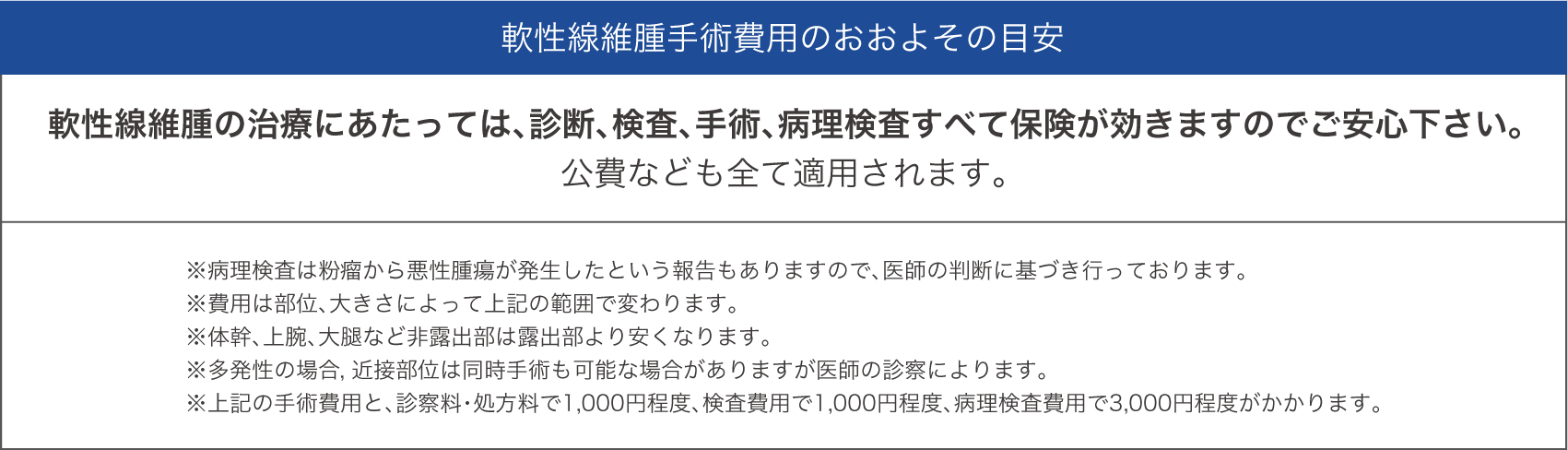
For skin tag treatment, diagnosis, examination, surgery, and pathological testing are all covered by health insurance. Public medical assistance programs are also accepted.
Our fees for skin tag treatment are as follows.
- Exposed areas: approximately ¥5,000–¥15,000
- Non-exposed areas: approximately ¥4,000–¥10,000
For further details on fees, please refer to the skin tag surgery fee schedule.
Please note that CO2 laser treatment is not covered by health insurance.
Frequently Asked Questions About Skin Tags

Here we answer some frequently asked questions about skin tags.
Skin tags are not viral warts, so there is no risk of passing them to others [1,16,17].
Any association with human papillomavirus (HPV) has also been refuted by large-scale studies, and skin tags have no infectivity whatsoever [16,17].
Skin tags most commonly develop on the neck and underarms, whereas viral warts tend to appear on the fingers, soles of the feet, face, arms, and other areas away from the neck.
Growths appearing on the neck or underarms are therefore less likely to be viral warts. However, if the growth is a viral wart, it may enlarge depending on the type. Rather than self-diagnosing, please consult a clinic to have your symptoms properly assessed.
Skin tags are benign growths. If you are not bothered by their appearance, leaving them untreated is generally not a problem.
However, you should not attempt to remove them yourself.
If the growth turns out not to be a skin tag but a viral wart, it may spread to surrounding skin.
Self-treatment carries a risk of worsening the condition.
Various creams are available that claim to remove skin tags and other warts, but many of these products lack clear medical evidence.
If you wish to address skin tags effectively, consulting a clinic is also worth considering.
The treatment costs for skin tag surgery are fully covered by health insurance [7,24].
Diagnosis, examination, and pathological testing are also covered. Surgical excision is also recognized as a standard treatment in domestic dermatology clinical guidelines [13].
The treatment approach—and therefore the cost—varies depending on the location and size of the growth, so please ask at the time of your consultation for specific cost information.
CO2 laser treatment for cosmetic purposes is not covered by health insurance.
During skin tag surgery, local anesthesia is used, so discomfort during the procedure is generally minimal.
You may feel some discomfort when the local anesthetic is administered, but our clinic uses ultra-fine needles to help minimize this.
However, some patients experience mild discomfort after the procedure once the anesthetic wears off.
Individual responses to pain vary, so please discuss any concerns with us at the time of your consultation.
Most over-the-counter products for removing warts are formulated with viral warts in mind.
Skin tags are not viral warts and are therefore outside the intended scope of such products.
Some over-the-counter products also carry warnings against use on seborrheic keratoses (age spots / senile warts), so correctly identifying the type of growth is important.
To avoid misidentifying a skin tag as a seborrheic keratosis or vice versa, please consider consulting a clinic for a proper evaluation.
Six Features of Our Clinic That Patients Appreciate
 Team-Based Care Under the supervision of board-certified plastic surgeons, our clinic includes physicians specializing in plastic surgery, dermatology, orthopedic surgery, and other disciplines.
 Attention to Discomfort Our specialist physicians select the most appropriate treatment from a broad range of surgical options, with the aim of minimizing patient discomfort.
 Minimal Scarring We perform surgical removal with the utmost care to avoid damage to the surrounding skin and to achieve a clean result.
 Insurance-Covered Treatment Available At our clinic, surgical excision using a scalpel is fully covered by health insurance.
 No Hospital Stay Required – Same-Day Surgery Available The process from consultation to surgery is smooth and efficient. Same-day surgery is available.
 Convenient Location We are located just a 3-minute walk from JR Shinjuku South Exit, a major central Tokyo transport hub.
Many of Our Patients Come to Us with the Following Concerns.
Do Any of These Apply to You?
Those who want to remove raised growths such as skin tags that have appeared on the neck, underarms, or similar areas
Busy professionals who cannot set aside extended time for treatment
Women who care deeply about the cosmetic outcome after their procedure
Our clinic carefully assesses the condition of each patient’s skin and recommends a treatment approach that minimizes scarring as much as possible. Our physicians bring broad knowledge and experience to every procedure—please do not hesitate to consult us.
References
- Japanese Dermatological Association, ed. Dermatology, 11th Edition. Bunkodo, 2018.
- Banik R, Lubach D. Skin tags: localization and frequencies according to sex and age. Dermatologica. 1987;174(4):180-183.
- Thappa DM. Skin tags as markers of diabetes mellitus: an epidemiological study in South India. J Dermatol. 1995;22(10):729-731.
- Crook MA. Skin tags and the atherogenic lipid profile. J Clin Pathol. 2000;53(11):873-874.
- Norris PG, Limova M, Saraiya A, et al. Acrochordons and insulin resistance. Cutis. 1988;42(4):362-364.
- Rasi A, Soltani-Arabshahi R, Shahbazi N. Skin tag as a cutaneous marker for impaired carbohydrate metabolism: a case-control study. Int J Dermatol. 2007;46(11):1155-1159.
- Japanese Society of Plastic and Reconstructive Surgery, ed. Plastic Surgery, 4th Edition. Kokuseido Publishing, 2017.
- Kahana M, Grossman E, Feinstein A, et al. Skin tags: a cutaneous marker for diabetes mellitus. Acta Derm Venereol. 1987;67(2):175-177.
- Demir S, Demir Y. Acrochordon and impaired carbohydrate metabolism. Acta Diabetol. 2002;39(2):57-59.
- Harii K, Hashimoto K, eds. NEW Dermatology, 3rd Edition. Nakayama Shoten, 2018.
- Gorpelioglu C, Erdal E, Ardicoglu Y, et al. Skin tags and their relation to diabetes mellitus, obesity and dyslipidemia. Indian J Dermatol. 2009;54(4):343-346.
- Jali R, Patil SS, Jali SM, et al. Study of serum lipid profile in skin tags. Indian J Dermatol. 2014;59(3):240-244.
- Japanese Dermatological Association. “Clinical Guidelines for Skin Tumor Management, 2nd Edition,” 2015.
- Rasi A, Soltani-Arabshahi R, Shahbazi N. Skin tag as a cutaneous marker for impaired carbohydrate metabolism: a case-control study. Int J Dermatol. 2007;46(11):1155-1159.
- El Safoury O, Rashid L, Ibrahim M. A study of skin tags in a group of Egyptian patients. J Egypt Womens Dermatol Soc. 2010;7(2):78-85.
- Dianzani C, Calvieri S, Pierangeli A, et al. The detection of human papillomavirus DNA in skin tags. Br J Dermatol. 1998;138(4):649-651.
- Erdogan BS, Aktan S, Rota S, et al. Skin tags and human papillomavirus: is there any association? Indian J Dermatol Venereol Leprol. 2005;71(3):181-184.
- Luba MC, Bangs SA, Mohler AM, Stulberg DL. Common benign skin tumors. Am Fam Physician. 2003;67(4):729-738.
- Yilmaz E, Kelekci KH, Kelekci S, et al. Skin tags: frequency and distribution in women according to age groups. Arch Gynecol Obstet. 2012;286(4):1031-1034.
- Bhargava P, Mathur SK, Mohan H, et al. Skin tags: a cutaneous marker for diabetes mellitus in Punjab (North West India). Diabetes Res Clin Pract. 1997;37(1):51-54.
- Mard SA, Nouri M, Moradi MT, et al. Study on skin tag, as a possible cutaneous sign of diabetes mellitus. Arch Iran Med. 2005;8(1):45-47.
- Editorial Committee of the Journal of the Japanese Dermatological Association. “Diagnosis and Treatment of Skin Adnexal Tumors.” Jpn J Dermatol. 2018;128(5):943-967.
- Rasi A, Soltani-Arabshahi R, Shahbazi N. Skin tag as a cutaneous marker for impaired carbohydrate metabolism. Int J Dermatol. 2007;46(11):1155-1159.
- Robinson JK, Hanke CW, Siegel DM, et al. Surgery of the Skin: Procedural Dermatology, 3rd Edition. Elsevier, 2015.
- Habif TP. Clinical Dermatology: A Color Guide to Diagnosis and Therapy, 6th Edition. Elsevier, 2016.
- Kittler H, Pehamberger H, Wolff K, et al. Diagnostic accuracy of dermoscopy. Lancet Oncol. 2002;3(3):159-165.
- Huang WM, Ault JM, Kuo DC, et al. Electrocoagulation and curettage for acrochordons: a safe and effective treatment. Dermatol Surg. 2011;37(5):708-712.
- Wang Y, Zhao Y, Ma S. Applications of cryotherapy in skin conditions. J Eur Acad Dermatol Venereol. 2015;29(4):631-638.